“30x whole genome” sounds like a settled fact. In practice it is often a marketing ceiling rather than the real average depth in your file, and that difference decides whether the test can even see your rare variants. Clinical grade whole genome sequencing is not a label you can print, it is a pipeline you have to run, from genuine 30x depth to a variant caller that clinical labs actually trust. Most consumer companies do not run it, and the file looks identical whether they did or not.
What a clinical-grade pipeline actually requires
True 30x depth across all 3.2 billion base pairs. SelfDecode uses 30x whole genome sequencing with paired-end Illumina reads, reading every position, not the few hundred thousand an array reads or the 1 to 2% an exome covers. “30x” means each position is read on average 30 times, the depth needed to call variants, including rare ones, with confidence.
A variant caller clinical labs trust. Variant calling uses DRAGEN, the same caller used by clinical labs worldwide and benchmarked against the PrecisionFDA Truth Challenges. Most consumer companies do not use DRAGEN, because it is expensive.
The current reference genome. Alignment is against GRCh38, the current human reference, not the outdated GRCh37 some providers still use, with quality filtering calibrated against Genome in a Bottle truth sets across ancestral backgrounds.
Measured, not asserted, accuracy. Sensitivity and specificity are measured against reference genomes. SelfDecode runs its own quality control and rejects files that do not pass it.
“30x” on the box does not mean 30x in the file
Here is the trap. When another company advertises “30x,” it is often a maximum, not a real average. In practice you may be getting 10x, which cannot call rare variants properly. Even a file labeled “30x” is usually not clinical-grade and cannot be used for real decisions. We learned this firsthand: we spent over a year and a half evaluating labs worldwide, ran our own quality control, sent files back, and required re-sequencing when the depth did not deliver.
Comparison chart
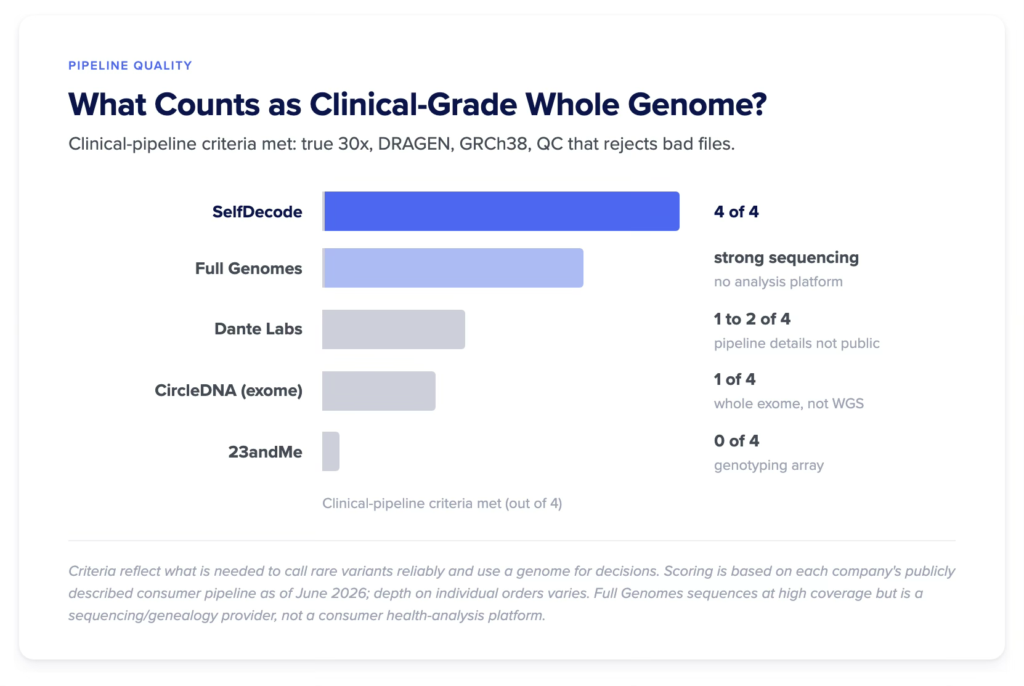
| Requirement | SelfDecode | Dante Labs | CircleDNA | 23andMe |
| Reads whole genome | Yes, true 30x | Advertised 30x, some reports lower | No, whole exome | No, array |
| DRAGEN variant calling | Yes | Not stated | Not stated | n/a |
| GRCh38 alignment | Yes | Varies | n/a | n/a |
| QC rejects bad files | Yes | Complaints reported | n/a | n/a |
How the others stack up
Dante Labs. Markets whole genome at 30x, and its sequencing is often described as good but variable; some customers and third-party reviews report receiving less than the ordered 30x. Its public record also includes extensive Better Business Bureau and Trustpilot complaints (long delays, lost kits, unresponsive support), and in 2021 to 2022 the UK Competition and Markets Authority secured customer refunds from Dante over its COVID-19 PCR testing business.
CircleDNA. Uses whole exome sequencing, which reads only the protein-coding part of the genome rather than the whole genome, so it cannot support the rare-variant calling a true 30x whole genome provides. It is a narrower kind of test, not a clinical-grade whole genome pipeline.
Full Genomes Corporation. It offers high-coverage whole genome. But it is a sequencing and genealogy provider, expensive (its 30x runs well over $1,000), and it does not give you a consumer health-analysis platform or validated risk scores on top. Good raw data, no analysis layer.
23andMe. Not whole genome at all. A genotyping array reads a fixed set of chip positions, so the clinical-pipeline question does not apply.
FAQ
What does “clinical-grade” whole genome sequencing mean?
A pipeline built to the standards clinical labs use: true 30x depth across the whole genome, a trusted variant caller (DRAGEN), alignment to the current GRCh38 reference, and quality control that rejects files that fail. It is the difference between data you can act on and data that only looks complete.
Is 30x whole genome sequencing enough?
30x is the accepted minimum for reliably calling variants, including rare ones, but only if it is genuine, quality-controlled 30x. Some companies advertise 30x and deliver far less, so the real number in your file matters more than the label.
What is DRAGEN?
DRAGEN is a variant caller used by clinical labs worldwide and benchmarked in the PrecisionFDA Truth Challenges. It is more accurate (and more expensive) than the tools many consumer companies use, which is why most do not run it.
Can I trust a “30x” label from any company?
Not automatically. “30x” is sometimes a maximum rather than a real average, and a file can read closer to 10x. Look for companies that measure sensitivity and specificity against reference genomes and reject files that fail QC.
See the pipeline for yourself
If you want a genome you can actually build health decisions on, start with clinical-grade whole genome sequencing, or read how the six levels of sequencing compare.
- Full Genomes coverage and pricing: https://isogg.org/wiki/Full_Genomes_Corporation
- Dante / UK CMA action: https://www.gov.uk/government/news/cma-action-secures-improvements-from-leading-pcr-testing-provider
Part of the Why Choose SelfDecode comparison. See also: The 6 levels of DNA sequencing and HLA, CYP2D6, and the regions most tests miss.