Almost every consumer DNA test sells personalized health risk scores. Far fewer can show you a validated polygenic risk score, one whose accuracy has been tested on people it was never trained on and published where other scientists can check it. That gap matters more than it sounds. An unvalidated risk score is not a slightly fuzzier version of the right answer, it is a different number that sends you toward different decisions. So “validated and published” is the first thing worth checking, and almost the whole industry fails it.
What a polygenic risk score actually is
Most common conditions, coronary artery disease, type 2 diabetes, breast cancer, Alzheimer’s, are not caused by one gene. They are influenced by thousands of small genetic effects spread across your whole genome. A polygenic risk score (PRS) adds those thousands of effects together into a single estimate of your genetic risk.
That is the only honest way to predict common-disease risk from DNA. It is also where the industry quietly falls apart, because building a PRS that is actually accurate is hard, and saying you have one is easy.
Why “backed by science” is not the same as “validated”
Here is what to watch for. A company says its reports are “backed by science” and links to PubMed. You click, and it is a single-variant association study: one RSID linked to one trait. The effect size of any single common variant is so small that it is clinically irrelevant on its own. No bioinformatician predicts a condition from a single variant (pharmacogenomics is the narrow exception). Citing a study is not the same as validating a model.
Real prediction requires an advanced, validated polygenic risk score, tested on independent populations and published so others can check it. That is the difference between citing science and doing science.
What SelfDecode actually did
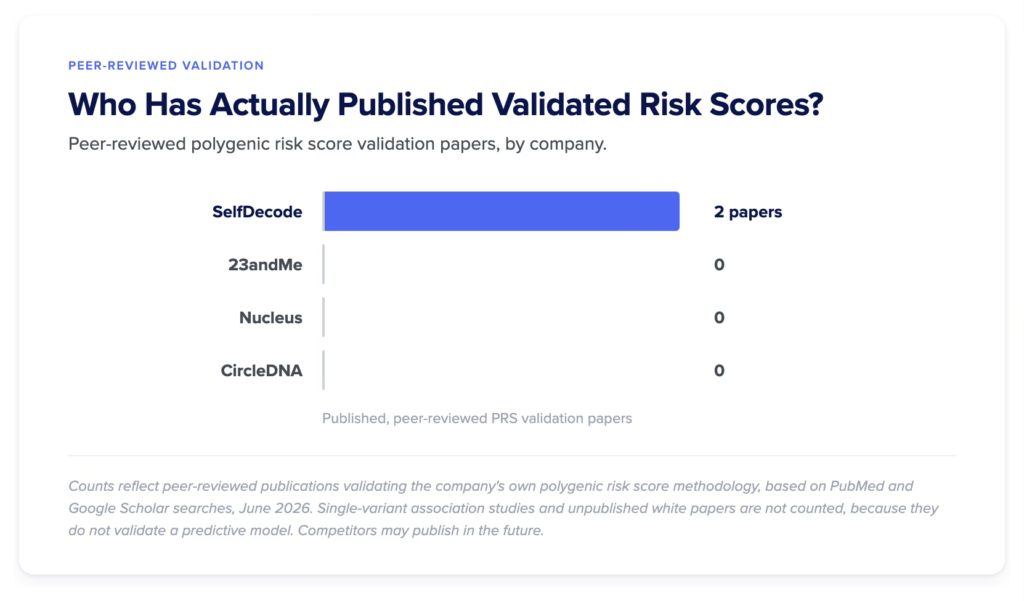
SelfDecode’s PRS methodology is published and peer-reviewed in two Nature journals:
- Scientific Reports (May 2025): Optimization of multi-ancestry polygenic risk score disease prediction models (Lerga-Jaso et al., 2025;15:17495). A peer-reviewed Nature journal.
- Nature Communications (May 2025): Tracing human genetic histories and natural selection with precise local ancestry inference, introducing the Orchestra ancestry model. Also a Nature journal.
The method combines an ensemble of five PRS algorithms trained on a trans-ancestry GWAS meta-analysis (UK Biobank, FinnGen, BioBank Japan, the Million Veteran Program, and others), which boosts case sample sizes about 6.4 times over UK Biobank alone. That is the engine. What it gives you is a score that is actually right for your biology, validated on independent cohorts rather than asserted. The benchmarking detail lives in its own breakdown: what makes a DNA health test accurate.
Why “not validated” really means “wrong”
This is the part the industry does not say out loud. When a company cannot show you a published, validated PRS, its scores are not in a gray zone of “probably close.” Without validation on independent populations, there is no reason to believe the number is near your real risk, and good reason (especially for non-European users) to believe it is not. A confidently-stated wrong answer is worse than no answer, because you act on it.
How the major DNA companies compare
| Company | Sequencing/data | Risk-score type | Published PRS validation |
| SelfDecode | Clinical-grade WGS (or imputed upload) | Advanced ensemble PRS, multi-ancestry | Yes, two Nature-journal papers |
| 23andMe | Genotyping array | Basic single-variant / array-based | No |
| Nucleus | Whole genome | PRS for 20+ conditions | None found |
| CircleDNA | Whole exome | Health and trait reports | None found |
How others stack up
23andMe. A genotyping array reads a fixed set of positions on a chip, not your whole genome. Any risk indicators it provides are basic, not advanced validated PRS, and there is no published, benchmarked validation behind them.
Nucleus Genomics. Nucleus does the sequencing well, that is the one thing it gets right. But the scoring is the weak link: it reports polygenic scores for 20+ conditions, and we found no peer-reviewed validation of those scores (an independent review notes several appear to be older open-source models). Without published validation, there is no way to confirm the numbers are accurate.
CircleDNA. CircleDNA uses whole exome sequencing, which reads only the protein-coding ~2% of the genome. It markets a long list of health and trait reports, but we found no published, validated PRS behind them.
The pattern holds across the major brand-name competitors: a PubMed search for them plus “polygenic risk score” or “validation” returns no results. We are not aware of another consumer genetics company that has published peer-reviewed validation of its own advanced disease-prediction PRS the way SelfDecode has, in two Nature-portfolio journals.
Frequently asked questions
Are consumer DNA risk scores accurate?
Usually only if the method has been validated on independent populations and published in peer review. Most consumer risk scores have not been, which means there is no evidence they match your real risk, and for non-European users they are frequently wrong.
Has any consumer DNA company published polygenic risk score validation?
As far as we can find, only SelfDecode, in two peer-reviewed Nature journals (Scientific Reports and Nature Communications, both 2025). A PubMed search of the major brand-name competitors plus “polygenic risk score” returns no validation papers.
Is a 23andMe risk estimate the same as a polygenic risk score?
No. 23andMe reads a genotyping array and provides basic, single-variant or array-based indicators. Those are not advanced, validated, published polygenic risk scores.
What does “validated” actually mean here?
That the scoring method was tested on independent cohorts it was not trained on, measured against reference models, and published so other scientists can check the result. SelfDecode’s ensemble was validated on the eMERGE Network and the PAGE Multiethnic Cohort.
See it on your own genome
If you have already tested with 23andMe or AncestryDNA, you can upload your raw data and get the same validated scores without re-sequencing, or start with clinical-grade whole genome sequencing. Either way, you can read the published papers and then check your own numbers inside SelfDecode.
Start with SelfDecode and get risk scores you can actually trust.
This is part of the Why Choose SelfDecode comparison. Related: accuracy across ancestries.