Some of the most medically consequential stretches of your genome are also the hardest to read, which is exactly why most tests skip them. A real HLA typing DNA test speaks to drug hypersensitivity, autoimmune risk, and transplant matching. CYP2D6 governs how you metabolize a long list of common medications. Both are notoriously difficult to call accurately, and difficulty, not importance, is usually what decides whether your test bothers to try.
The regions other tests skip
- Structural variants. Detected reliably, including the deletions, duplications, inversions, and CNVs behind conditions like spinal muscular atrophy (SMN1) and 22q11 deletion syndrome. These are invisible to a standard array.
- Mitochondrial DNA. Analyzed alongside the nuclear genome, not ignored.
- HLA typing. Full-resolution immune-system typing, the most clinically consequential and hardest-to-type region, linked to autoimmune risk, drug hypersensitivity, and transplant compatibility.
- CYP2D6. Typed at the resolution real pharmacogenomic prescribing requires. CYP2D6 has structural variants, duplications, and a pseudogene that make it notoriously hard to type, which is precisely why most consumer products do not attempt it.
For uploaded genotype data, imputation expands a 750,000-SNP file to 200M+ variants at about 99.7% accuracy, so even 23andMe and AncestryDNA customers get validated scores without re-sequencing, though true HLA and CYP2D6 resolution is a sequencing-grade capability.
Why these regions are hard (and why that matters)
A genotyping array reads fixed, easy positions. An exome reads the coding 2%. Neither is built to resolve a region like CYP2D6, where a nearby pseudogene and structural rearrangements can fool a naive caller into the wrong result. Getting HLA and CYP2D6 right requires whole genome data and a pipeline designed for the hard cases. This is not a feature most consumer companies skip by choice, it is one they cannot reach with their underlying technology.
Comparison chart
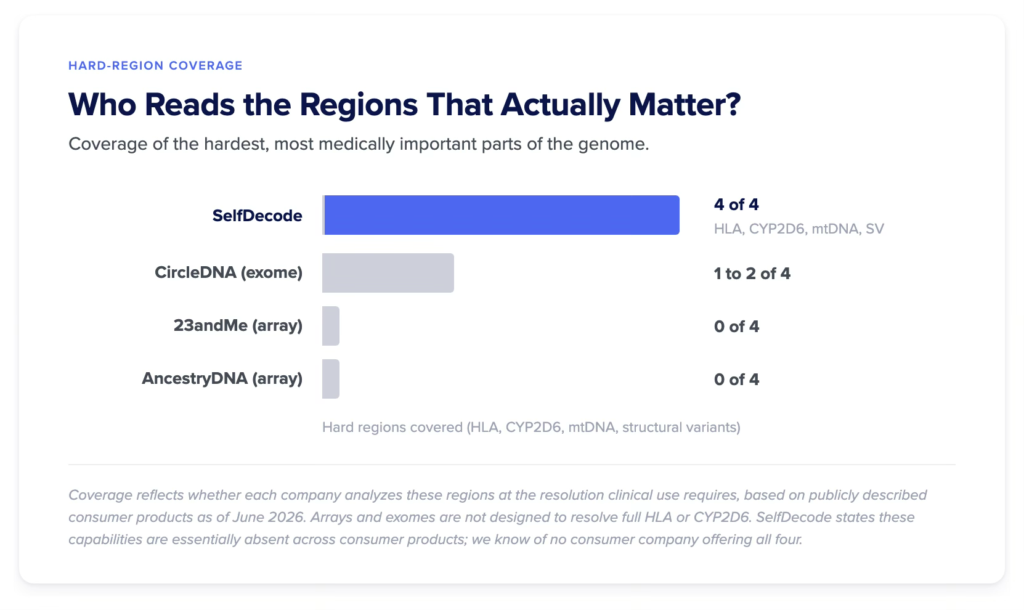
| Region | SelfDecode | CircleDNA (exome) | 23andMe / AncestryDNA (array) |
| Full HLA typing | Yes | No | No |
| CYP2D6 (PGx-grade) | Yes | Limited | No |
| Mitochondrial DNA | Yes | Limited | No |
| Structural variants / CNVs | Yes | Limited | No |
How the others stack up
23andMe and AncestryDNA. Genotyping arrays read a fixed set of positions and are not built to resolve HLA, CYP2D6, mitochondrial DNA, or structural variants. These regions are simply outside what the technology can see.
CircleDNA. Whole exome sequencing covers the coding regions, so it captures some variants an array misses, but it is not designed for full HLA typing, PGx-grade CYP2D6, or comprehensive structural-variant and mitochondrial analysis.
Accurate HLA, CYP2D6-grade pharmacogenomics, and mitochondrial analysis are essentially absent in most consumer products. We do not know a single consumer company, besides SelfDecode, that offers all of them.
FAQ
What is HLA typing and why does it matter?
HLA typing reads the immune-system region linked to autoimmune risk, drug hypersensitivity, and transplant compatibility. It is the hardest region to type accurately, which is why most consumer tests do not offer full-resolution HLA. SelfDecode does.
Can 23andMe test CYP2D6?
Not at pharmacogenomic-prescribing resolution. CYP2D6 has structural variants, duplications, and a pseudogene that a genotyping array cannot resolve. Accurate CYP2D6 typing needs whole genome data and a purpose-built pipeline.
Do consumer DNA tests read mitochondrial DNA?
Most do not. SelfDecode analyzes mitochondrial DNA alongside the nuclear genome as part of its standard whole genome analysis.
What are structural variants?
Larger changes like deletions, duplications, inversions, and copy-number variants, behind conditions such as spinal muscular atrophy and 22q11 deletion syndrome. They are invisible to arrays but detectable from clinical-grade whole genome data.
See what your test can actually read
Understand why this depends on sequencing quality in the 6 levels of DNA sequencing, or start with clinical-grade whole genome sequencing.
Part of the Why Choose SelfDecode comparison. See also: What is clinical-grade whole genome sequencing?.