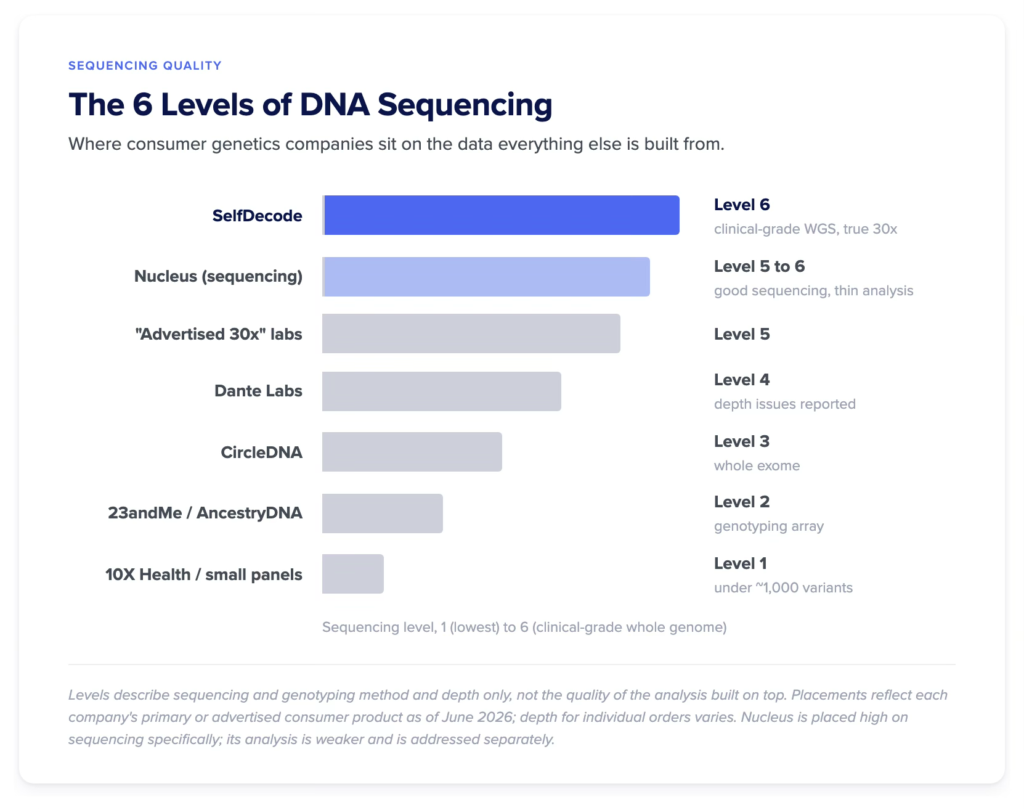
Two products can both call themselves a “DNA test” and still differ by a factor of thousands in how much of your genome they actually read. The clearest way to compare them is to rank the levels of DNA sequencing, from a handful of variants up to a genuinely clinical-grade whole genome. There are roughly six rungs on that ladder. Once you can see them, where any company sits, and where it is quietly hoping you will not look, becomes obvious.
The 6 levels, bottom to top
Level 1, the worst: 1 to 1,000 variants. Most consumer and functional-medicine companies look at somewhere between one and a thousand genetic variants and build their entire pitch on it. A handful of variants cannot predict traits or conditions. This is the bottom of the market.
Level 2: genotyping arrays without good imputation. These read the 700,000 to roughly 1 million positions printed on a chip and nothing more, so you only ever see the variants the array happened to test. This is where 23andMe and AncestryDNA sit.
Level 3: whole exome. This reads the protein-coding part of the genome, about 2%. Better than an array in some ways, but it misses too much. You cannot do good polygenic risk scores, you cannot do full pharmacogenomics, and you cannot reliably call rare variants in the other 98%. CircleDNA is the well-known example, using whole exome sequencing.
Level 4: poor-quality whole genome sequencing. Companies advertise “whole genome,” but depth matters enormously. Below 30x (anywhere from 1x to 29x) you cannot accurately call rare variants. Dante Labs is often placed here: its sequencing is described as good but variable, and some customers and third-party reviews report receiving less than the ordered 30x.
Level 5: advertised 30x whole genome. Here the sequencing is marketed as true 30x, even by legitimate labs, but check the underlying data and it often is not actually 30x, so it still misses the rare variants real 30x is meant to catch.
Level 6, where SelfDecode operates: genuinely clinical-grade whole genome. A true minimum 30x, paired-end Illumina reads across all 3.2 billion base pairs, DRAGEN variant calling (the same caller used by clinical labs worldwide), GRCh38 alignment, and quality control that rejects files that do not pass. We spent over a year and a half evaluating labs, ran our own quality control, and sent files back for re-sequencing when they failed. Most consumer companies do not do this.
Sequencing is only half of it
It is one thing to sequence a whole genome, another to actually analyze all of it. Even the rare competitor that sequences genuinely well tends to read only narrow slices: ACMG findings, basic carrier screening, and a weak PRS, leaving the overwhelming majority of your genome unanalyzed.
Nucleus Genomics is the clearest example of why this distinction matters. Its sequencing is genuinely good, a real strength and the one thing it gets right, so on raw sequencing it sits high on this ladder. But the analysis is thin: essentially ACMG findings plus basic carrier screening plus polygenic scores with no peer-reviewed validation, and no intelligent recommendations or multi-omics. Strong sequencing does not, by itself, make the downstream scores reliable.
SelfDecode analyzes across your entire genome and turns it into the most comprehensive output in the industry: the most comprehensive pharmacogenomics and carrier reports available, nutrigenomics, pathway analysis, HLA typing, mitochondrial and rare-variant analysis beyond the ACMG list, and 1,500+ polygenic risk scores. And because it is your file, SelfDecode reanalyzes the same genome forever as the science advances, so your cost per insight approaches zero over time.
Comparison chart
| Level | What it is | Example company | Can it do validated PRS + full PGx? |
| 6 | Clinical-grade WGS, true 30x, DRAGEN, QC | SelfDecode | Yes |
| 5 | Advertised 30x WGS (often not true 30x) | Various labs | Partially |
| 4 | Low-depth WGS (1x to 29x) | Dante Labs | No |
| 3 | Whole exome (~2% of genome) | CircleDNA | No |
| 2 | Genotyping array | 23andMe, AncestryDNA | No |
| 1 | Single-variant / small panels | 10X Health and similar | No |
How the others stack up
10X Health and single-variant panels (Level 1). Reporting on a handful of genes. A small panel sold at a premium ($599 for the 10X methylation test) is still a small panel.
23andMe and AncestryDNA (Level 2). Genotyping arrays read only the positions on the chip. Useful for ancestry, but they cannot see the rest of your genome, so rare variants and good polygenic scoring are out of reach.
CircleDNA (Level 3). Whole exome reads the coding ~2% of the genome. It captures many known disease variants but misses the non-coding regions that regulate genes and most of what polygenic scoring needs.
Dante Labs (Level 4). Markets 30x whole genome, but some customers and third-party reviews report receiving less than the ordered 30x, and its public record includes extensive Better Business Bureau and Trustpilot complaints about long delays, lost kits, and unresponsive support.
Nucleus (high sequencing, thin analysis). Good sequencing, which is why it sits high on this specific ladder, but the analysis layer is limited and we found no peer-reviewed validation of its polygenic scores. Sequencing well is necessary, not sufficient.
FAQ
Is whole genome sequencing better than 23andMe?
Yes, for health analysis. 23andMe reads a genotyping array (a fixed set of positions), while whole genome sequencing reads all 3.2 billion base pairs. Only the genome-wide data supports advanced polygenic risk scores and full pharmacogenomics.
What is 30x whole genome sequencing?
“30x” means each position in your genome is read on average 30 times, which is the depth needed to call variants, including rare ones, with confidence. Some companies advertise 30x but deliver less, so genuine, quality-controlled 30x is what to look for.
Is whole exome sequencing enough?
Whole exome reads only the protein-coding ~2% of the genome. It captures many known disease variants but cannot support good polygenic risk scoring or reliable rare-variant calling across the whole genome.
Does sequencing depth actually matter?
Yes. Below 30x you cannot reliably call rare variants, so a low-depth “whole genome” can quietly miss the findings it is supposed to catch. Depth is one of the main things that separates the six levels.
See where your data sits
If you already have data from a Level 2 array (23andMe, AncestryDNA), you can upload it to SelfDecode and run it through validated scoring, or start with clinical-grade whole genome sequencing to get the full picture.
Part of the Why Choose SelfDecode comparison. See also: What is clinical-grade whole genome sequencing? and Are DNA risk scores accurate?.