Here is an uncomfortable number: roughly 86 percent of the participants in the genetic studies behind modern risk scores are of European descent, though Europeans are about 16 percent of the world. That imbalance is the hidden reason DNA test accuracy by ethnicity is so uneven. If you are Black, Hispanic, East Asian, South Asian, or of mixed background, a score built mostly on European data is extrapolating by the time it reaches you, and extrapolation is where accuracy quietly collapses.
The number behind the problem
The genetic studies that risk scores are built from are overwhelmingly European. In the GWAS Catalog, participants were about 86.5% of European descent as of 2023, even though people of European ancestry are only about 16% of the global population. African-ancestry representation sits near 1%. A score trained mostly on European data and applied to a non-European person is extrapolating, and extrapolation is where accuracy quietly collapses.
This is why an array-based score reported as a clean percentile can be, for most non-European users, simply wrong, while looking just as confident as a correct one.
How SelfDecode is built differently
- Higher-resolution ancestry. The Orchestra local-ancestry model resolves ancestry at far higher granularity than the continental-level estimates other platforms use, so your variants are interpreted in your ancestral context.
- Training designed for diversity. The training meta-analysis was specifically designed to improve performance in non-European populations, and validation reports performance separately for each group (Black or African, Asian, White, Latino, Native American, Hawaiian, Japanese).
- Sequencing carries no ancestry bias. Whole genome sequencing reads every position regardless of ancestry. Unlike genotyping arrays designed against European reference panels, the technology itself carries no built-in bias.
Comparison chart
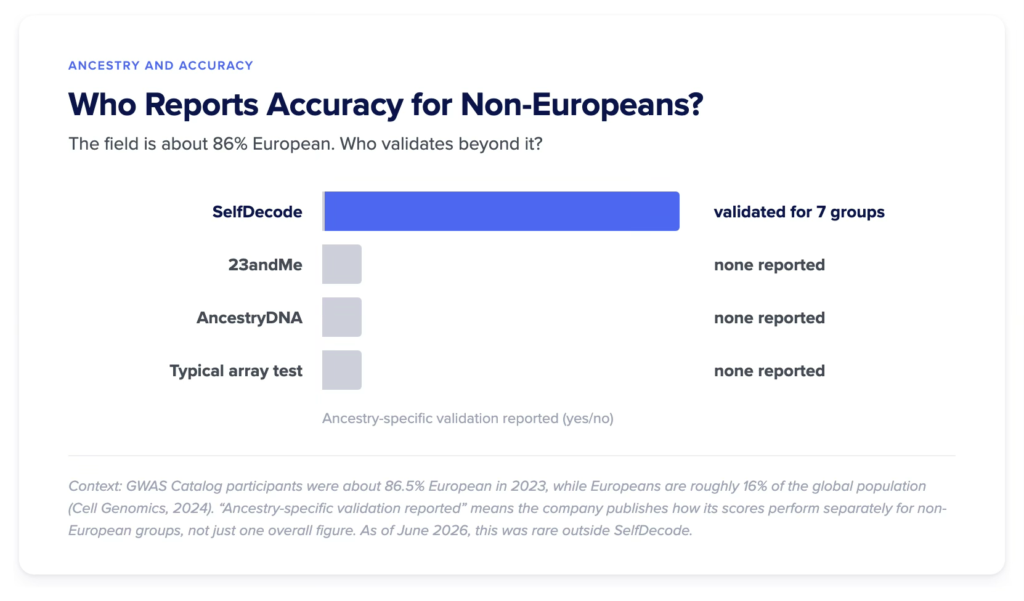
| Company | Sequencing/data | Ancestry resolution | Validation reported per ancestry group? |
| SelfDecode | WGS or imputed upload | Local ancestry (Orchestra) | Yes, 7 groups |
| 23andMe | Genotyping array | Continental-level | No |
| AncestryDNA | Genotyping array | Continental-level | No |
| Typical array test | Genotyping array | Continental-level | No |
How the others stack up
23andMe and AncestryDNA. Both are strong ancestry-composition products, but for health risk they rely on continental-level ancestry estimates and array data, and neither publishes how its risk indicators perform separately for non-European groups.
Array-based health tests generally. Most report a single percentile with no ancestry breakdown. For a non-European user, that percentile may be extrapolated well outside the data it was built on, with no warning that its reliability has dropped.
FAQ
Are DNA risk scores accurate for non-Europeans?
Often not, unless the score was specifically built and validated for diverse ancestries. Most were trained on roughly 86% European data, so they extrapolate for everyone else. SelfDecode reports validation separately for non-European groups.
Why does ancestry affect genetic risk accuracy?
Because risk scores learn from the populations they were trained on. Applied to an ancestry that is underrepresented in the training data, the same score becomes less reliable and can be wrong while still looking confident.
How does SelfDecode handle ancestry?
With a local-ancestry model (Orchestra) that resolves ancestry at high granularity, a training set designed to improve non-European performance, validation reported per group, and whole genome sequencing that reads every position without array bias.
Is the ancestry accuracy gap solved?
No, and SelfDecode says so directly: the field-wide gap has been narrowed, not closed. The difference is that SelfDecode measures and reports it rather than ignoring it.
See how it applies to you
Upload your data to see your scores in your ancestral context.
- Diversity-gap paper (Cell Genomics, 2024): https://www.cell.com/cell-genomics/fulltext/S2666-979X(24)00353-7
- Orchestra ancestry paper (Nature Communications): https://www.nature.com/articles/s41467-025-59936-3
Part of the Why Choose SelfDecode comparison. See also: Are DNA risk scores accurate?.