It is tempting to assume the most accurate DNA health test is whichever one stamps “peer-reviewed” on the box. Publication is the floor, not the ceiling. The real question is whether a company’s risk scores have been put head to head with the best reference models in the field, on populations they were never trained on, and come out ahead. That is a much higher bar, and it is the one SelfDecode set out to clear rather than simply assert.
What “accurate” means in polygenic scoring
Accuracy here is measured, not claimed. The standard metric is AUC (area under the curve), which captures how well a score separates people who develop a condition from those who do not. A score is only trustworthy if it posts strong AUC on independent validation cohorts, populations that were not part of building it.
SelfDecode’s models were validated on the eMERGE Network and the PAGE Multiethnic Cohort, two of the most respected independent multi-ancestry validation cohorts, both containing populations not used in training. That is the honest test, and it is the one most companies never run.
The benchmark numbers
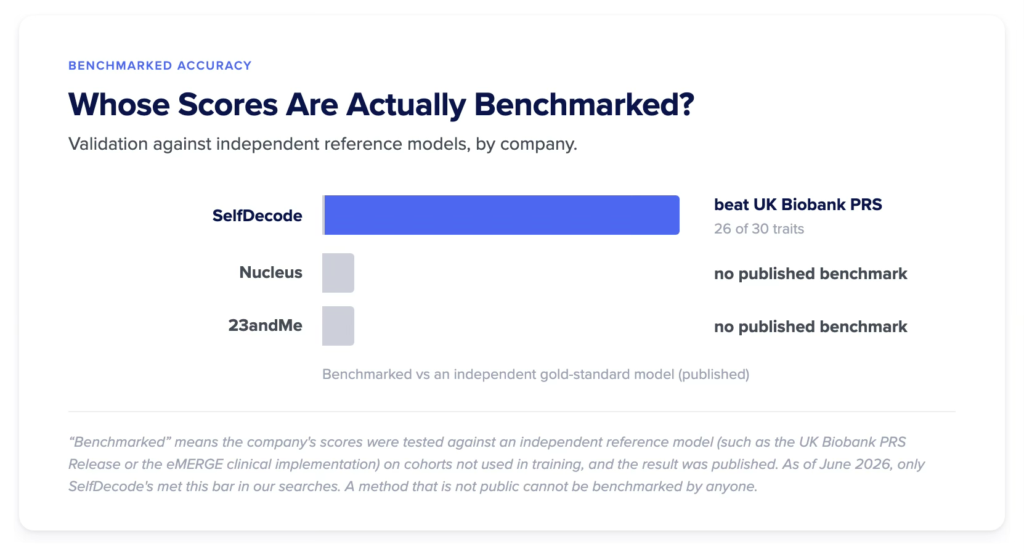
- The SelfDecode ensemble outperformed the UK Biobank PRS Release (Thompson et al., 2024) for 26 of 30 traits, with a median AUC improvement of 5.07%.
- It beat the eMERGE clinical PRS implementation for 6 of 8 overlapping traits.
- 12 of 30 models exceed 80% AUC with clinical factors, and 19 traits exceed a diagnostic odds ratio of 10 across all ancestry groups.
- The coronary artery disease PRS identifies 55 to 80 times more true coronary events than rare pathogenic-variant models, because it captures the large pool of people whose risk comes from common variants, not the rare mutations that get all the attention.
Validation spans 150 medically-related conditions; the published paper details 30 of them, and a further paper is set to validate the full 150.
Why competitors cannot show you this
Here is the structural problem with the rest of the market: you cannot benchmark a method that was never made public. Most competitors do not publish their scoring methodology, so there is nothing to check, nothing to compare against eMERGE or the UK Biobank, and no result anyone outside the company can trust. “Backed by science” with no public method is not the same as a benchmarked, validated score.
Comparison chart
| Company | Methodology public? | Validated on independent cohorts? | Beats reference models? |
| SelfDecode | Yes, two Nature-journal papers | Yes, eMERGE + PAGE | Yes, 26 of 30 vs UK Biobank |
| 23andMe | No | No | No benchmark |
| Nucleus | No | No published validation | No benchmark |
How the others stack up
Nucleus. Reports polygenic scores for a few dozen conditions, but we found no peer-reviewed validation or published benchmark of them, so there is no AUC and nothing to compare against eMERGE or the UK Biobank.
23andMe. Provides array-based indicators with no published, benchmarked validation behind them, so their accuracy cannot be independently measured.
FAQ
Which DNA health test is the most accurate?
The most accurate is the one whose scores are validated on independent populations and benchmarked against the best reference models. SelfDecode’s ensemble beat the UK Biobank PRS Release for 26 of 30 traits on independent multi-ancestry cohorts, which no other consumer company has published.
What is AUC in a DNA risk score?
AUC (area under the curve) measures how well a score separates people who develop a condition from those who do not. SelfDecode reports 12 of 30 models exceeding 80% AUC with clinical factors, measured on cohorts not used in training.
Why can’t competitors show benchmark numbers?
Because a method that is not published cannot be benchmarked by anyone. Most competitors do not make their scoring methodology public, so there is no independent result to compare.
What cohorts were SelfDecode’s scores validated on?
The eMERGE Network and the PAGE Multiethnic Cohort, two respected independent multi-ancestry cohorts containing populations not used in training.
See the benchmarks for yourself
Read the published paper, then look at how the same validated scoring holds across ancestries.
- PRS paper (Scientific Reports): https://www.nature.com/articles/s41598-025-02903-1
Part of the Why Choose SelfDecode comparison. See also: Are DNA risk scores actually accurate?.