“Backed by science” is the most common phrase in health content and the least informative. Click the citation and it is usually a single association study with an effect too small to act on. Genuinely science-backed genetic testing means something you can audit: named MD, PhD, and pharmacist reviewers, sources you can click through to, and risk claims grounded in validated scoring rather than one convenient variant. The difference is simply whether you can check the work.
What the editorial standard actually is
- Qualified people write it. The editorial team includes MDs, PhDs, pharmacists, and qualified scientists, and writers whose past work appeared on unreliable health sites are rejected.
- Every claim is checkable. Articles cite specific PubMed sources you can click through to, content is updated as the science evolves, and the sourcing rules, writer vetting, and internal peer review are publicly documented, not just asserted.
- The claims rest on real prediction. Crucially, SelfDecode’s claims rest on validated polygenic scores, not on cherry-picked single-variant association studies.
Why “cites science” and “does science” are different
This is the core of it. Linking to a study is not the same as building on validated science. A great deal of health content points to one RSID-and-one-trait association paper, where the effect of that single variant is too small to matter clinically, and presents it as proof. A real editorial standard does two things that marketing does not: it sources every claim to something you can read, and it grounds its risk claims in validated polygenic scoring rather than a single hand-picked variant. That is the line between citing science and doing it.
Comparison chart
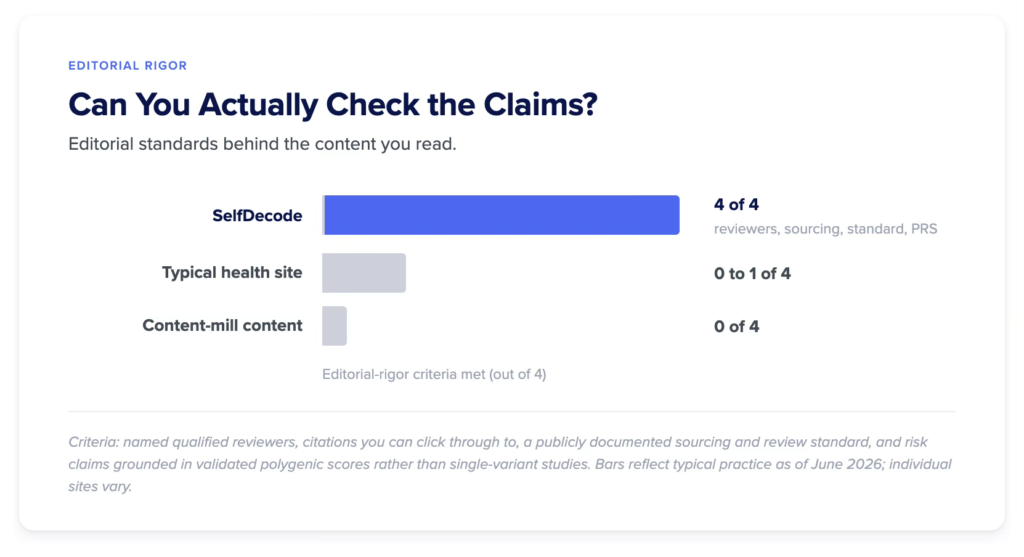
| Criterion | SelfDecode | Typical health site |
| Written/reviewed by MDs, PhDs, pharmacists | Yes | Rarely disclosed |
| Click-through PubMed sourcing | Yes | Sometimes, often weak |
| Publicly documented editorial standard | Yes | No |
| Claims grounded in validated PRS | Yes | No |
How the others stack up
Most consumer health content is produced without any public editorial standard. There is no disclosed reviewer, no documented sourcing policy, and “backed by science” usually means a single link to one association study with a clinically irrelevant effect size. Content-mill health pages take it further, optimizing for search rankings rather than accuracy, with no qualified review at all. The contrast is not subtle: SelfDecode documents who writes and reviews its content and grounds its claims in validated scoring you can verify.
FAQ
Who writes SelfDecode’s content?
An editorial team of MDs, PhDs, pharmacists, and qualified scientists. Writers whose past work appeared on unreliable health sites are rejected, and content is internally peer reviewed.
Is SelfDecode actually science-backed?
Yes, and in a checkable way: articles cite specific PubMed sources you can click through to, the sourcing and review standard is publicly documented, and risk claims rest on validated polygenic scores rather than single-variant studies.
Why is “backed by science” not enough on its own?
Because it often means a link to one association study whose single-variant effect is too small to be clinically meaningful. Real rigor requires checkable sourcing and validated prediction, not a citation for show.
Is the content kept up to date?
Yes. Content is updated as the science evolves, rather than published once and left to age.
See the standard
Read how the editorial rigor connects to the scientific team and to validated, published scoring.
Part of the Why Choose SelfDecode comparison. See also: Are DNA risk scores accurate?.