Your genome sets a baseline, but it cannot tell you what your last blood panel said. A multi-omics health platform takes all of it, your DNA, your labs, your lifestyle, even your microbiome, and reads it together rather than in separate silos. That is a fundamentally different product from a one-time DNA test, and it changes what a single rising lab value actually means for you.
What “multi-omics” actually means here
Upload and analyze any of your data. SelfDecode ingests your DNA (sequenced in-house or uploaded from another provider), your blood and lab results, your microbiome results, and your lifestyle inputs (as PDF, photo, or manual entry), then uses AI to analyze all of it as one picture rather than in silos.
1,000+ biomarkers, read against your genome. The Lab Test Analyzer supports 1,000+ biomarkers (CBC, vitamins, hormones, metabolic, liver and kidney, inflammation, and microbiome results) in US and international units, and interprets each result against your genetic baseline rather than a generic reference range.
Longitudinal and connected. Lab tracking is longitudinal, and lifestyle inputs (diet, sleep, exercise, stress, alcohol, and dozens more) feed the same engine, so every recommendation synthesizes across all inputs instead of treating each test as a standalone.
The honest distinction from “DNA + blood” products
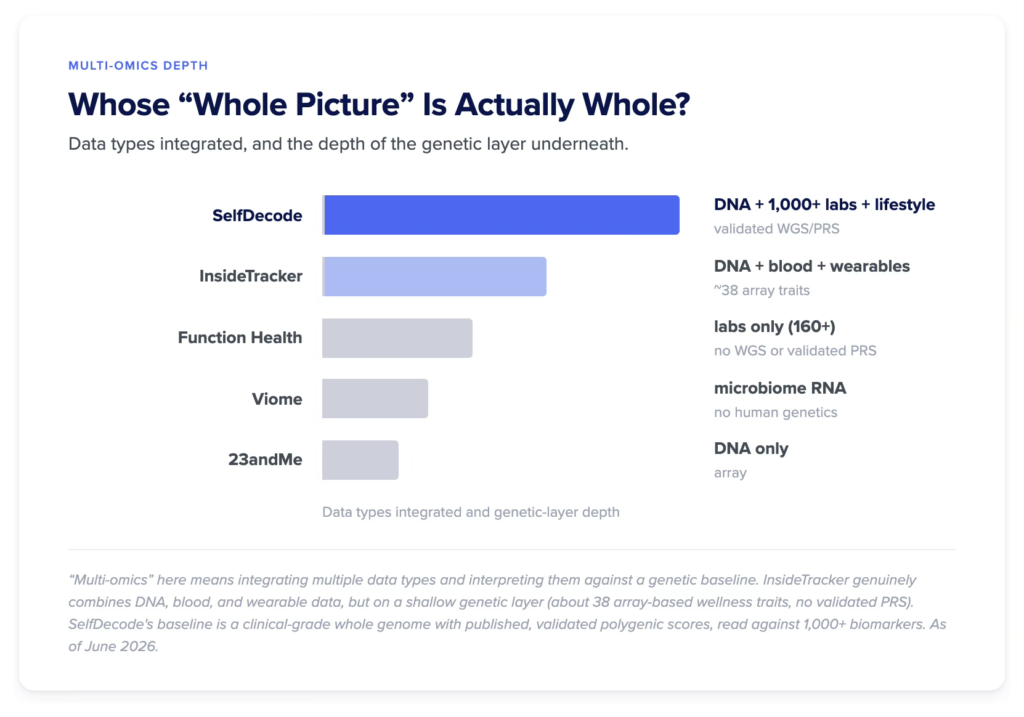
Some platforms do combine more than one data type, and it is worth being precise about the difference rather than pretending no one else touches multiple inputs. The real distinction is the depth and validation of the genetic layer, and how many biomarkers actually get interpreted against it.
SelfDecode’s genetic baseline is a clinical-grade whole genome with published, validated polygenic risk scores across 1,500+ reports. Its Lab Test Analyzer reads 1,000+ biomarkers against that baseline. Most “combined” products sit on a shallow genetic layer (a few dozen wellness traits from a genotyping array, with no validated PRS) and a narrower biomarker panel. Combining data is the easy part. Combining it on a validated, whole-genome foundation is the part almost no one does.
Comparison chart
| Company | Data types integrated | Genetic layer | Biomarkers interpreted vs genome |
| SelfDecode | DNA + labs + lifestyle + microbiome | Clinical-grade WGS, validated PRS | 1,000+ |
| InsideTracker | DNA + blood + wearables | ~38 array wellness traits | ~40+ |
| Function Health | Labs only (+ Grail cancer screen) | None | 0 (no WGS/PRS) |
| Viome | Microbiome RNA | None (microbial RNA) | n/a |
| 23andMe | DNA only | Array | 0 |
How the others stack up
InsideTracker. It does combine a DNA kit (about 38 wellness traits from roughly 20,000 array markers), 40+ blood biomarkers, and wearable data from Apple Health, Fitbit, Garmin, Oura, and Strava. Where it falls short of true multi-omics is depth: the genetic layer is a small set of array-based wellness traits with no validated polygenic risk scores and no whole genome, and the product is built around a recurring blood-test subscription rather than a whole-genome foundation. SelfDecode interprets far more biomarkers against a validated genetic baseline.
Function Health. A strong, useful lab-testing membership ($365 per year for 160+ lab tests, HSA/FSA eligible). It added a Grail DNA-based multi-cancer screen in 2024, but it does not offer whole-genome sequencing or validated polygenic scores, so it is not multi-omics in the genetic sense. SelfDecode’s Lab Test Analyzer covers similar bloodwork and adds the validated genetic baseline Function does not have.
Viome. Analyzes microbial mRNA (RNA, not human DNA) for gut and oral health, producing 50+ scores. It is not interpreting your human genome at all, so it is not comparable on genetic multi-omics.
23andMe. DNA only, on a genotyping array, with no lab or lifestyle integration.
FAQ
What is a multi-omics health platform?
A platform that integrates multiple types of health data (DNA, lab results, lifestyle, microbiome) and interprets them together rather than in isolation. SelfDecode reads 1,000+ lab biomarkers and lifestyle inputs against your validated genetic baseline.
Can I upload my lab results to SelfDecode?
Yes. You can upload blood and lab results, microbiome results, and lifestyle inputs as PDF, photo, or manual entry, and the Lab Test Analyzer interprets 1,000+ biomarkers against your genetic baseline, in US or international units.
How is SelfDecode different from InsideTracker?
InsideTracker combines a small set of DNA wellness traits with blood and wearable data. SelfDecode’s genetic layer is a clinical-grade whole genome with validated polygenic scores, and it interprets 1,000+ biomarkers against it, a deeper and validated foundation.
Why interpret lab results against my genome?
Because the same number means different things for different people. A rising LDL at the 90th percentile of cardiovascular polygenic risk is not the same as at the 30th. Reading labs against your genetic baseline makes the interpretation personal rather than generic.
See it work on your own data
Upload your labs and lifestyle alongside your DNA, or bring raw data from another provider to build your genetic baseline first.
Part of the Why Choose SelfDecode comparison. See also: 20,000+ personalized recommendations and SelfDecode AI.