You can change a leaked password. You cannot change your genome. That is what makes “is DNA testing private” a different question from ordinary data privacy, and why the only answers that count are concrete ones: does the company sell your data, share it with insurers, and what becomes of it if the company is acquired or goes bankrupt. The genetics industry has spent the last years turning that final question from hypothetical into headline.
The specific protections
- Not sold, not shared with insurers. SelfDecode does not sell genetic data and does not share it with health, life, long-term-care, or disability insurers. Data is encrypted.
- You own it and can delete it. You can delete your data, export it, and research participation is opt-in, not opt-out. Law-enforcement access requires valid legal process, and privacy protections survive acquisition or bankruptcy.
- The regulatory bases are covered. Practices are HIPAA-aligned (medical components), GDPR-compliant for EU users (access, erasure, explicit consent), GINA-compliant across US employment and health-insurance contexts, and honor CCPA and other regional frameworks where applicable.
Why “survives bankruptcy” is not a small detail
The genetics industry has made this abstract concern very concrete. When a company is acquired or goes bankrupt, its most valuable asset is often the database it built, and customers can find their genetic data treated as part of the sale. The protection that matters is one that travels with your data regardless of what happens to the company. SelfDecode commits that privacy protections survive acquisition or bankruptcy, which is exactly when weaker promises tend to evaporate.
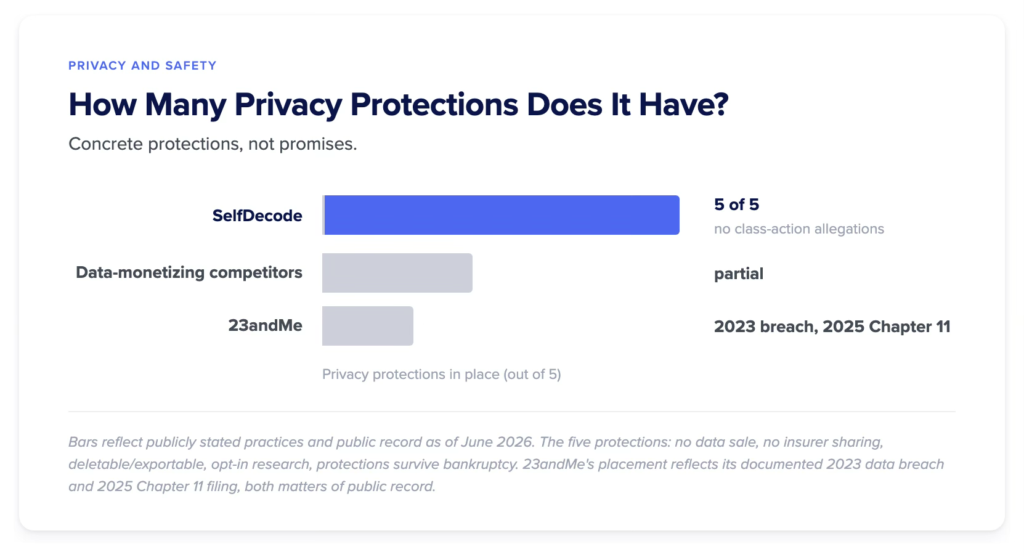
Comparison chart
| Protection | SelfDecode | 23andMe |
| Does not sell genetic data | Yes | Poor record |
| Not shared with insurers | Yes | n/a |
| Delete and export your data | Yes | Varies |
| Research is opt-in | Yes | Varies |
| Protections survive bankruptcy | Yes | Filed Chapter 11 in 2025 |
How the others stack up
23andMe. Carries a notably poor privacy reputation: it suffered a large-scale data breach in 2023 and filed for Chapter 11 bankruptcy in 2025, the exact scenario that makes “what happens to my data if the company fails” a live question rather than a hypothetical. SelfDecode does not sell identifiable data and has no class-action allegations over unauthorized sharing.
Data-monetizing competitors generally. Much of the industry’s business model leans on data, whether through research partnerships, resale, or insurer-adjacent uses. The contrast is simple: SelfDecode does not monetize your data the way much of the industry does.
FAQ
Is DNA testing private?
It depends entirely on the company. With SelfDecode, your data is encrypted, not sold, not shared with insurers, deletable and exportable, opt-in for research, and protected through acquisition or bankruptcy.
Can DNA companies sell my genetic data?
Some business models depend on it. SelfDecode does not sell genetic data and does not share it with health, life, long-term-care, or disability insurers.
What happens to my DNA data if the company is acquired or goes bankrupt?
With SelfDecode, privacy protections survive acquisition or bankruptcy. This matters because a genetic database is often a company’s most valuable asset in a sale, as the 23andMe Chapter 11 case made clear.
Is SelfDecode GINA and HIPAA compliant?
SelfDecode’s practices are HIPAA-aligned for medical components, GINA-compliant across US employment and health-insurance contexts, GDPR-compliant for EU users, and honor CCPA and other regional frameworks where applicable.
See the full policy
Read how privacy connects to SelfDecode’s 11-year track record and consistent ownership.
Part of the Why Choose SelfDecode comparison. See also: SelfDecode AI.