Overview
- Products: Ancestry, Health & Trait Genetic Analysis using 23andMe DNA testing kits
- Cost: Ancestry + Traits ($99); Health + Ancestry ($199)
- Reports: Analyzes ancestry across 45 different populations, analyzes genetic traits, genetic health risk results, and carrier statuses
- Raw data access: Yes, users can download their raw DNA data
- Privacy:If given consent, genetic information may be used for scientific research and published studies. Regardless of consent, user genetic data may be shared with third-party partners as part of the company’s customer data protection practices.
- Alternatives: Health – SelfDecode; Ancestry – AncestryDNA, MyHeritage, FamilyTreeDNA
23andMe DNA Results Pros and Cons
| Pros | Cons |
| – Analyzes DNA for both ancestry and health using 23andMe genetic testing – One of the largest DNA databases on the market, making it convenient for finding relatives, DNA matches, and genetic matches among millions of people – Aesthetically pleasing and user-friendly interface for viewing ancestry and health results – User DNA used to empower 23andMe research for consented individuals | – Discloses user DNA and data to third-party partners regardless of consent status, creating 23andMe customer data protection concerns – Doesn’t allow raw data uploading from other companies, which is different from DNA platforms like SelfDecode – Lack of SNPs being analyzed to compile risk; reports analyze only 1 or 2 SNPs associated with each condition – Lack of coverage for health-related matters; only 56 health conditions were assessed in total – No customized lifestyle recommendations are given to counteract genetic risk |
About 23andMe as a DNA Service Provider
23andMe was founded in 2006 in Sunnyvale, CA by Molecular Biologists Anne Wojcicki and Linda Avey. 23andMe was one of the very first direct-to-consumer autosomal DNA service providers offered to the public. In 2007, Google invested $3.9 million into the company. Wojcicki was married to Google co-founder Sergey Brin at the time. Genentech, New Enterprise Associates, and Mohr Davidow Ventures also had early investments in the company.
Today, 23andMe is one of the largest direct-to-consumer DNA companies on the market, boasting 10 million people in its database as of 2020. 23andMe’s primary mission is to revolutionize the health and wellness sector through user data research while delivering ancestry, health, and trait results to consumers.
Review of 23andMe Products & Features
23andMe Genetic Testing Products and DNA Testing Kits
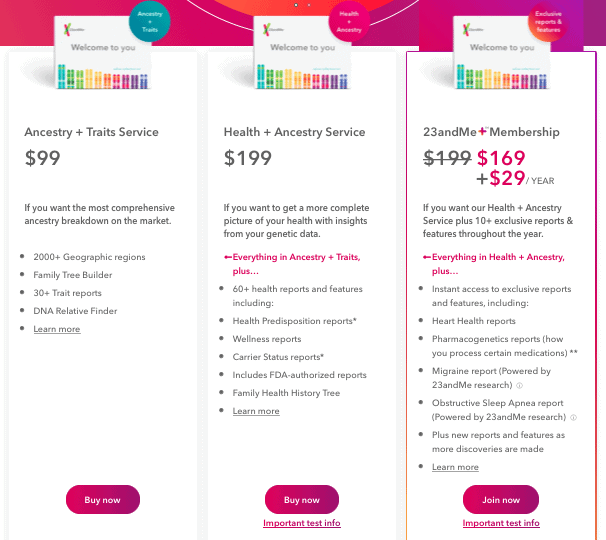
23andMe offers direct-to-consumer DNA testing kits for health and ancestry analysis. Customers will be able to choose from 3 different genetic testing services: Ancestry + Traits ($99), Health + Ancestry ($199), and a 23andMe+ Membership (introductory offer of $169 + $29/month). These 23andMe DNA test kits are designed for consumers interested in ancestry, traits, and health-related results.
23andMe Ancestry + Traits DNA Test Features
The 23andMe Ancestry + Traits DNA test includes the following features:
- Ancestry Composition Report
- DNA Relatives Feature
- DNA Relatives Feature for identifying relatives and DNA matches
- Haplogroup Reports detailing maternal and paternal haplogroups
- Neanderthal Ancestry Report, including analysis of Neanderthal DNA
Additional Features in the Health + Ancestry Service
In addition to the reports listed above, the Health + Ancestry service includes:
- Carrier Status Reports
- Health Predisposition Reports
- Wellness Reports
- Expanded genetic reports covering genetic health risk results
A 23andMe+ Membership offers exclusive access to new health reports and advanced ancestry features. However, it is only available to those on 23andMe’s latest genotyping chip.
Ancestry Reports and Estimates
Their ancestry portion analyzes ancestry across 45 different populations and more than 1,500 ancestral locations, delivering detailed ancestry estimates and a clear ancestry timeline. Ancestry is divided into five regional categories: European; Middle Eastern and North Africa; East Asian and Native American; Sub-Saharan African; and Oceanian.
The reports also include maternal and paternal haplogroups, as well as the number of Neanderthal DNA variants detected. These insights help users better understand their ancestors and population history.
You can view a sample report here.
Traits, Facial Features, and Other Analysis
The trait section analyzes 30 different traits that are related to appearance or senses. Examples of traits analyzed include food preferences, facial features, and other inherited characteristics. These other traits are based on associations within genomic DNA and are presented as probabilities rather than certainties.
Wellness Reports and Genetic Breakdown
The Wellness section analyzes how a person’s DNA may interfere with diet, sleep, and exercise and consists of eight reports. This section provides a limited genetic breakdown, especially when considering the wide range of possible health-related genetic markers.
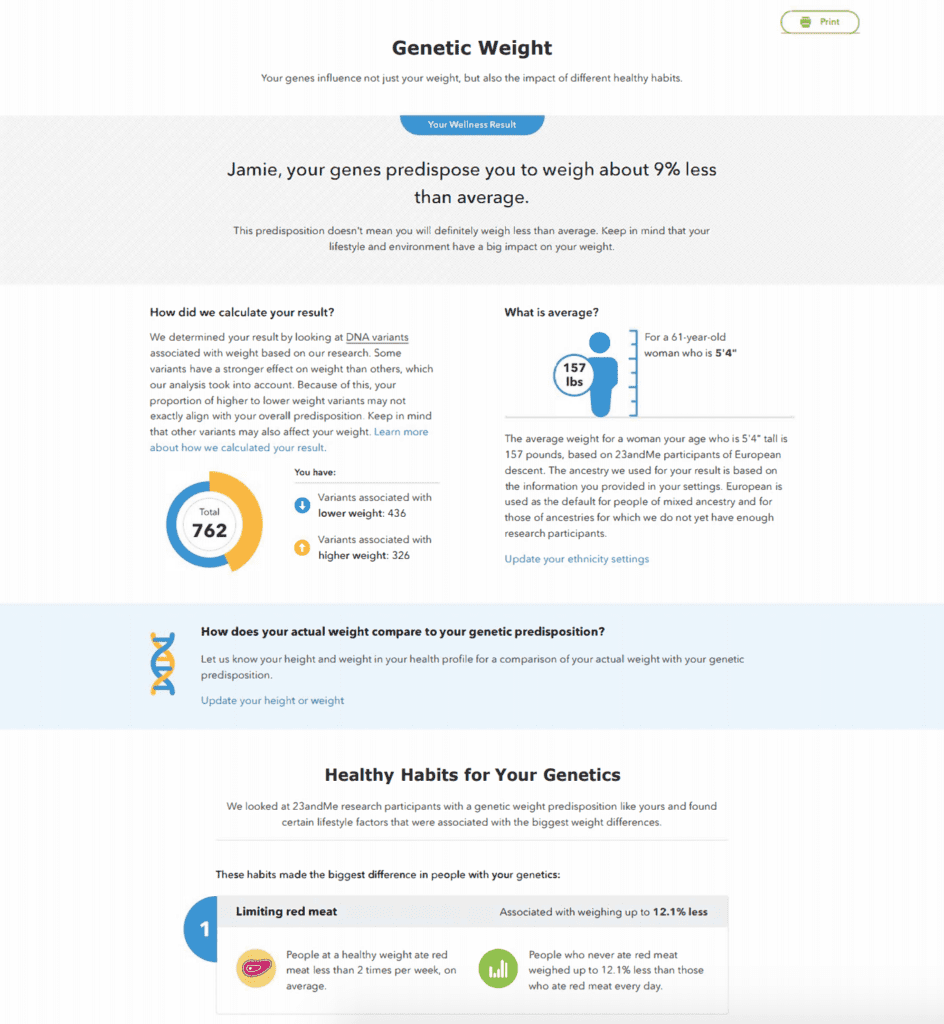
Below is an example of a 23andMe Wellness Report that discusses weight. As shown, this Wellness Report calculates the total number of variants a person may have associated with weight and uses this to calculate the overall odds of a person’s tendency to weigh more or less.
Health Predisposition Reports and Genetic Health Risk Results
The Health Predisposition section provides genetic health risk results for 14 medical conditions and diseases, as well as carrier status for 44 conditions. These reports focus on identifying inherited risk rather than diagnosing disease.
The Health Predisposition section analyzes the following categories:
- Late-Onset Alzheimer’s disease
- BRCA-related cancer risk involving the BRCA1 and BRCA2 genes
- MUTYH-Associated Polyposis
- Parkinson’s disease
- Age-related Macular Degeneration
- Celiac Disease
- Alpha-1 Antitrypsin Deficiency
- Familial hypercholesterolemia
- Hereditary Amyloidosis (TRR-Related)
- Hereditary thrombophilia (HFE-Related)
- Type 2 Diabetes
In each Genetic Health Risk report, it will display your overall genetic likelihood for the condition. It displays a brief description of the condition, the associated gene, and the scored allele. It will also include other useful information such as the ethnic demographics the condition is commonly found in and how the condition is commonly treated.
You can also view another sample report here.
Carrier Status Reports and Family Planning Insights
The Carrier Status Reports are designed to show whether traits may be passed on to children and potentially impact future family history. These reports focus on rare genetic disorders with serious health implications and are relevant for individuals planning families or researching inherited conditions affecting close family members.
You can view a sample report here.
Health Recommendations and DNA Accuracy Limitations
23andMe provides an analysis of 14 health conditions for a user’s genetic risk and 44 carrier status reports. In each evaluated condition, only one or two SNPs are analyzed, which may limit overall DNA accuracy. While general lifestyle tips are included, the recommendations are not personalized based on an individual’s complete genetic information.
14 health conditions is a low amount of coverage relative to the wealth of medical research on DNA and what could be gleaned from raw DNA files. For those who choose to get a 23andMe+ membership, the company offers 12 additional health reports and access to their pharmacogenomics report. However, this upgrade is not available to every customer, only those on their latest genotyping chip.
In each of the health conditions evaluated, only 1 or 2 SNPs are evaluated. 23andMe leaves out many important SNPs in each of their reports that have been proven to have strong genetic implications for the condition. This makes 23andMe’s computations for genetic likelihood less accurate or informative.
In addition to this, while 23andMe informs the user of their genetic risk, they provide little to no guidance on how a user can alleviate their genetic risk. The action plans are not customized to the individual’s DNA. Instead, general lifestyle tips are included in every report that is in everyone’s best interest.
Review of 23andMe Privacy & Data Security
23andMe has built their business model on sharing consumer data with third-party businesses and research organizations for financial incentives and scientific insights. A significant portion of 23andMe’s earnings comes from sharing user data with these partners.
For users who consent to share their DNA, genetic information and survey responses may be published in peer-reviewed journals. Data is aggregated and stripped of names and contact information before research use.
Unfortunately, 23andMe also shares its entire user DNA database with third-party research partners regardless of consent status.
23andMe Partnerships and Research Initiatives
Some of the partners given access to this data include pharmaceutical and biotechnology companies. A notable partnership is with GlaxoSmithKline, one of the largest drug makers in the world, which has exclusive rights to mine 23andMe customer data for drug targeting. GlaxoSmithKline has also invested $300 million into 23andMe.
23andMe also has a partnership with Airbnb granting them exclusive rights to consumer data. This partnership bridges ancestry with travel and appeals to Airbnb’s heritage tourism market demographic.
As of 2020, 23andMe has been dabbling into the pharmaceutical industry, having created its first-ever in-house drug, an initiative that investors predict will become a lucrative break-through for the DNA company. 23andme has developed a partnership with pharmaceutical company Almirall to further develop and market this drug.
In January 2021, 23andMe announced they will go public through a partnership with the Virgin Acquisition Group, a firm backed by billionaire Richard Branson.
Other notable partnerships include Genentech, Pfizer, TrialSpark, and universities such as Stanford University and the Broad Institute of MIT and Harvard, as well as nonprofit medical organizations like the Lupus Research Institute and Michael J. Fox Foundation. 23andMe is also involved in research initiatives with government-funded genome collections in the U.K. and Finland.
23andMe Total Health Review
The 23andMe Health + Ancestry service provides genetic health risk results, carrier status reports, and wellness insights based on genomic DNA collected from saliva samples. The 23andMe DNA test analyzes reporting of 44 variants for carrier status and evaluates specific conditions such as hereditary cancers linked to the BRCA1 and BRCA2 genes. While the genetic reports are easy to understand and deliver quality results for basic screening, they assess limited SNPs per condition, which may affect DNA accuracy compared to more comprehensive DNA services.
23andMe Family Tree Builder Review
23andMe does not offer a traditional family tree builder like AncestryDNA or MyHeritage, but it includes a Relative Finder that identifies DNA matches and close family members within its database. Users can connect with people they are genetically related to, explore shared ancestors, and build basic family connections manually. This approach supports genealogy and family history discovery, though it lacks advanced family tree tools, ancestry timelines, and structured tree-building features found in dedicated genealogy platforms.
AncestryDNA vs 23andMe
AncestryDNA focuses on genealogy, family trees, and DNA matches, while 23andMe emphasizes genetic reports, health insights, and trait analysis. 23andMe provides accurate ancestry breakdowns, haplogroups, Neanderthal DNA estimates, and ancestry composition, including insights such as whether a user has one of the highest percentages of Neanderthal DNA reported by 23andMe. AncestryDNA and MyHeritage, however, offer larger genealogy databases, more DNA matches, and stronger tools for building family trees and tracing ancestors over generations.
23andMe Results, Matches, and Relatives
Results include ancestry composition, haplogroups, traits, and health insights. The relative finder identifies DNA matches, relatives, and close family members. Many people use matches to connect with family and friends and expand their family tree.
23andMe vs SelfDecode Comparison
- 23andMe offers genetic insights into 56 health conditions. SelfDecode offers genetic insights on thousands of health conditions.
- 23andMe shares consumer DNA to third-party organizations and scientific research. This is a core aspect of their business model. SelfDecode does not share any consumer data with third-party organizations, government agencies, or research institutions.
- 23andMe computes a user’s risk for a condition by cherry-picking one or two SNPs associated with the condition. SelfDecode compiles as many of the most scientifically valid SNPs to compute overall genetic risk for a condition.
- 23andMe recommends only general lifestyle tips and does not customize its action plan according to one’s genetic makeup. SelfDecode creates a customized in-depth action plan with science-based lifestyle, supplement, and diet recommendations based on each individual’s genetic makeup.
- 23andMe only offers 56 reports and doesn’t allow for users to explore pertaining health topics or genes in other varied or in-depth ways. SelfDecode offers a variety of ways for users to explore their genetics through the Wellness Reports, Personalized Genetics Blog, and Symptoms Analyzer. If a user is interested in a specific health topic or gene, they can explore it more through our robust database, blog articles, and search engine.
- 23andMe does not allow users to upload DNA files to their services. SelfDecode allows users to upload DNA files. You can learn more about the kind of DNA files they accept here.
23andMe Reviews, Alternatives, and Summary
| SelfDecode | 23andMe | Nebula Genomics | Dante Labs | |
| Comprehensive personalized holistic health recommendations | Yes | No | No | No |
| One-click regimen builder | Yes | No | No | No |
| Products | DNA testing, wellness reports, research-based health recommendations | DNA testing, traits, wellness reports, more accurate ancestry | WGS, health reporting, traits, ancestry | WGS, health and fitness reporting, genetic health risks |
| Raw data access | Yes | Yes | Yes | Yes |
| Cost (USD) | $97 – $397 | $99-$199 | $0 (limited) – $700 | $670 |
23andme Reviews
Trustpilot – 135 Customer Average Rating of 1.8 of 5 stars
Reviewers on Trustpilot are fairly negative regarding 23andMe’s services. The most common complaints have to do with poor customer support regarding account troubleshooting & 23andMe DNA test kits delivery issues as well as “vague” results.
Read what people are saying about 23andMe on Twitter.
The 23andMe hashtag on Twitter is a great place to find out more information about the history of the company and find some articles written about it.
Read what people are saying about 23andMe on Reddit.
Alternatives to 23andMe
SelfDecode is the best option for health-related DNA analysis on the market. SelfDecode offers an array of user-friendly features to help users make sense of the most important health implications of their genetic data and provides comprehensive genetic reports.
For ancestry services, AncestryDNA is a viable alternative. They have the largest DNA database out of all the direct-to-consumer DNA testing kits companies, making it a good candidate for users interested in finding DNA matches and relatives.
Unfortunately, like 23andMe, AncestryDNA also shares genetic information with third-party partners. MyHeritage is another option for building family trees and connecting family through matches. FamilyTreeDNA is another alternative for users interested in haplogroups and long-range matches.
23andMe Review Summary
23andMe has become a well-known company for analyzing DNA and has done a strong track record of providing in-depth ancestry insights due to the large number of genetic files in its database.
For users who are primarily interested in learning more about their genealogy and do not have a strong focus on health, 23andMe’s genetic health risk analysis may be sufficient. However, the health insights are limited, as the conditions covered are typically analyzed using only one or two SNPs associated with each condition. As a result, these health insights are limited in scope and less scientifically robust.
23andMe has also raised concerns around user data privacy, as it allows third-party partners to access its user DNA files. Many of these partners are large pharmaceutical and technology companies with commercial interests.
For those seeking deeper health-related insights, an alternative such as SelfDecode can provide personalized genetic reports across a wide range of health topics. SelfDecode analyzes up to 83 million genetic variants using AI and machine learning to generate personalized health recommendations based on your DNA. With SelfDecode, genetic data is not sold or shared with third parties.
SelfDecode
It may not be readily apparent to most people who don’t know much about DNA, so let’s get some perspective here:
23andMe analyzes only one genetic variant for some health reports – but the human body is made up of about 324 million known variants from sequenced human genomes. So, testing for one small variant in the grand scheme of things may not always be so accurate.
SelfDecode analyzes as many genetic variants as possible per report, with some of their reports analyzing over 1 million for one specific health topic. Moreover, SelfDecode’s extensive science team only includes the most up-to-date, research-backed information when creating each recommendation. This means each DNA report along with each personalized recommendation made for you based on your genes is as accurate as possible – so you can start taking action on your health as soon as you discover your prioritized recommendations from SelfDecode.
If accuracy and comprehensive health information is something you’re looking for in a DNA company, then give SelfDecode a try.
FAQ
23andMe Genetic Testing: How Does It Work?
The 23andMe DNA test uses saliva samples to extract genomic DNA. Users collect saliva at home using a 23andMe kit, mail it back, and receive results online. This explains how 23andMe DNA testing works using modern DNA testing kits.
Is 23andMe Accurate DNA Test?
23andMe provides accurate ancestry breakdowns and basic genetic reports, but health predisposition reports analyze only 1–2 SNPs per condition, which may limit overall DNA accuracy. For comprehensive health insights, alternatives like SelfDecode analyze millions of genetic variants.
Is 23andMe Legit?
Yes. 23andMe is a legitimate direct-to-consumer DNA testing kit provider offering ancestry, traits, and health reports. It is widely used for building family trees, identifying relatives, and understanding genetic information. However, users should be aware of 23andMe customer data protection practices regarding third-party access.
How long does 23andMe take to process DNA results?
Most 23andMe DNA testing kits take approximately 3–5 weeks from the time the saliva sample is collected until the results are available online. This timeline may vary depending on lab processing and shipping.
Can 23andMe help me find relatives and matches?
Yes. The DNA relatives feature allows users to connect with relatives, close family members, and genetic matches. Users can also explore family history and build detailed family trees using their genetic information.
What kind of ancestry information does 23andMe provide?
23andMe provides comprehensive ancestry breakdowns, including ancestry estimates, maternal and paternal haplogroups, and Neanderthal DNA analysis. The ancestry timeline shows regional origins across 45 populations and more than 1,500 ancestral locations.
What is included in 23andMe health reports?
Health reports include genetic health risk results, carrier status for inherited conditions, and wellness insights. They are part of the Health + Ancestry service or 23andMe+ Membership, which also provides expanded genetic reports and actionable insights based on genomic DNA.
Can I use 23andMe with other platforms like MyHeritage or AncestryDNA?
No. 23andMe does not allow uploading of raw DNA data from other services. Users seeking interoperability may consider alternatives like MyHeritage, AncestryDNA, or FamilyTreeDNA to combine results and expand family and matches discovery.